


Implantology – precise, minimally invasive and tailored to you
We offer the full spectrum of modern implantology – from minimally invasive implant placement to complex restorations with extensive bone augmentation. Thanks to digital 3D planning and state-of-the-art implant systems, implants can be positioned with millimetre precision to achieve a natural, functional and aesthetic result.
Our experienced implantologists, surgeons and prosthodontic specialists work hand in hand – for maximum safety, quality and precision in every phase of treatment.
Immediate implant placement
What does immediate implant placement mean?
Normally, after a tooth has been extracted, we wait a few weeks for the gum and bone to heal before an implant is placed. With immediate implant placement, the implant is inserted straight after the tooth has been removed – in other words, in the same treatment session.
This saves time and often a second procedure as well.
When is this possible?
Immediate implant placement can only be carried out if the situation in the mouth allows it.
This means:
- There must be no acute inflammation at the site
- There must be enough bone for the implant to be held securely
- The gum and the bone walls should be largely intact
- The patient should have good oral hygiene and be in good general health
If these conditions are met, immediate implant placement is a quick and gentle solution.
What is immediate loading?
Normally, an implant needs a few months to heal in before it is fitted with a crown or bridge.
With immediate loading, the patient receives a temporary crown shortly after the implant has been placed (usually within 1–2 days).
The implant is therefore put to use straight away – for example, for a natural smile in the visible area.
When is this an option?
Immediate loading is only possible if the implant is very firmly anchored and the load on it can be well controlled.
This depends on the bone, the stability and also the patient’s bite.
Advantages of both procedures
- Shorter treatment time
- Fewer surgical procedures
- Faster aesthetic result (“a new tooth straight after extraction”)
- Better preservation of bone and gum
However:
Not every situation is suitable. If, for example, there is inflammation, insufficient bone or poor stability, it is safer to place the implant only after a healing period.
Ceramic implants
Ceramic implants – natural, metal-free and biocompatible
For patients who place particular value on metal-free solutions, we offer modern ceramic implants.
They are made of biocompatible high-performance ceramic, which is extremely well accepted by the body and, thanks to its light, tooth-like colour, blends particularly naturally and aesthetically with the gum.
Ceramic implants are ideal for sensitive people or those prone to allergies, and offer excellent long-term tolerability and stability.
All-on-4 method
All-on-4 method – “fixed teeth in one day”
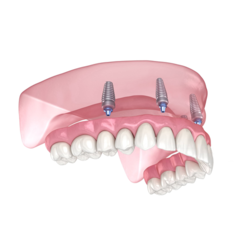
With the modern All-on-4 implant method, we can give patients a complete, fixed row of teeth within a single day. This innovative technique offers a fast, safe and aesthetic solution for people who have lost several teeth or would like to avoid a removable denture.
On request, we perform the procedure under general anaesthesia – ideal for anxious patients.
The technique
The All-on-4 method developed by Prof. Paulo Malo is a modern, proven technique that helps patients with missing teeth regain fixed dental prostheses – often without extensive bone augmentation.
In this method, four specially angled implants are placed in the jaw.
Two implants are positioned vertically in the front of the jaw, while the two rear implants are inserted at a specific (tilted) angle.
This allows the existing bone to be used to best effect, even if it has already receded somewhat.
As a result, the bone augmentation that would otherwise be needed is usually unnecessary.
A fixed temporary bridge can be attached to these implants on the very same day – so you leave the practice with fixed, natural-looking teeth.
After the healing phase, the final, custom-made restoration is fitted.
This technique offers many advantages
- No lengthy bone augmentation procedures needed
- Shorter treatment time
- Fixed teeth straight away and natural aesthetics
- High stability and wearing comfort
- Particularly suitable for people who have lost several teeth or already wear removable dentures
Bone augmentation
Bone augmentation – the foundation for stable implants
After a tooth has been lost, the jawbone often gradually recedes over time.
The reason: the bone is no longer stimulated by the natural forces of chewing and therefore loses height and width.
Inflammation, periodontitis or a long period without teeth can also lead to bone loss.
However, for a dental implant to hold securely and permanently, there must be sufficient bone volume.
If this bone is missing, it can be restored through targeted bone augmentation (bone grafting).
Depending on the initial situation, we use the patient’s own bone, bone substitute material or a combination of procedures.
In certain cases, the Khoury method (bone shell technique) or a sinus lift is also used to create a stable foundation for the implant.
Sinus lift
Sinus lift
If an implant is to be placed in the side of the upper jaw (back molars), the existing bone is sometimes not sufficient.
The reason: over time, the jawbone can recede after tooth loss, while at the same time the maxillary sinus (sinus maxillaris) drops slightly.
In a sinus lift, the floor of the maxillary sinus is gently raised and the space created is filled with bone or bone substitute material.
This restores sufficient bone height for an implant to be anchored securely and permanently.
In our practice, the procedure is performed minimally invasively under local anaesthesia.
Depending on the initial situation, the implant can be placed at the same time or in a second step after a short healing period.
Thanks to modern techniques such as piezosurgery and 3D diagnostics (CBCT), the procedure is particularly precise and gentle.